Ken Griffin Doubles Down on Miami. Here's What That Really Tells Us.
This week, one of the most powerful signals in American capital migration was sent not from a trading floor, but from a stage at the Milken Institute Global Conference in California.
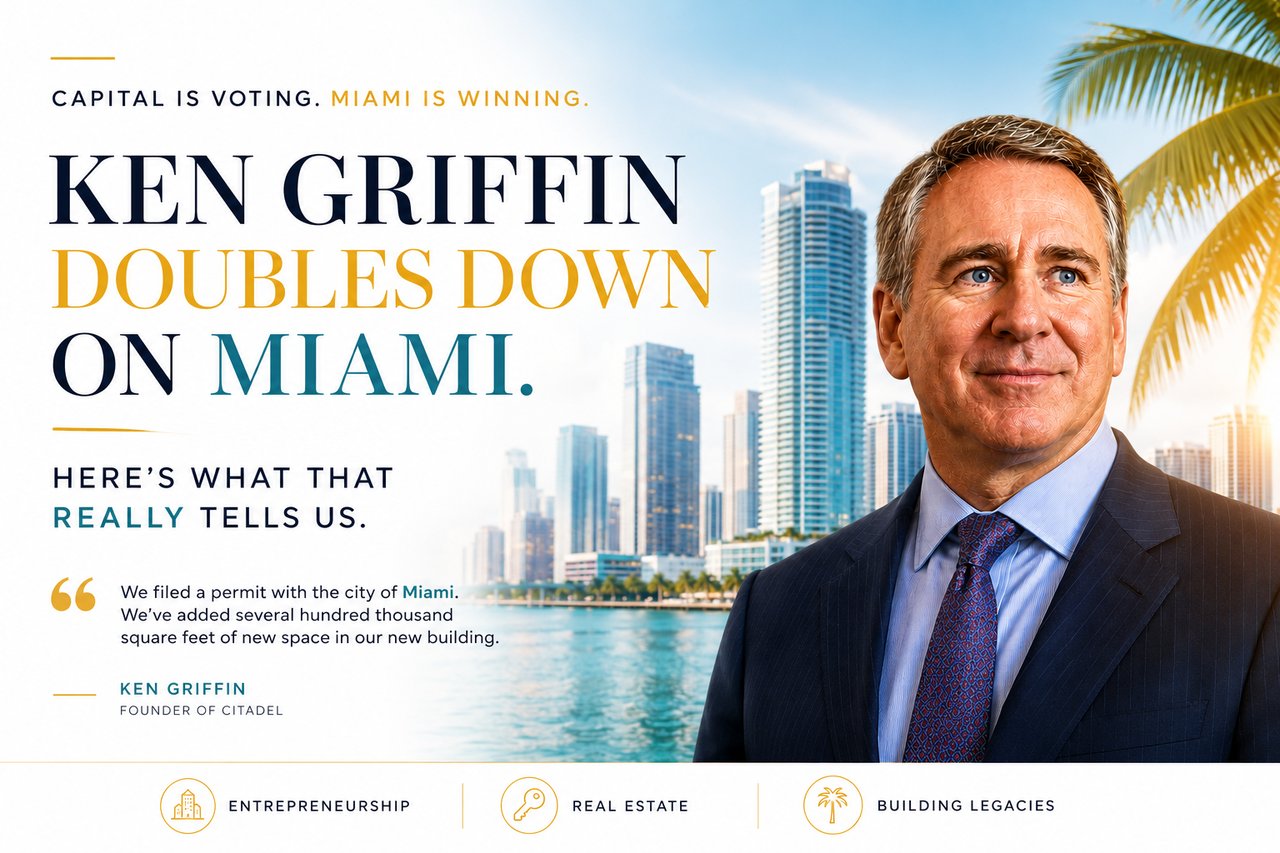
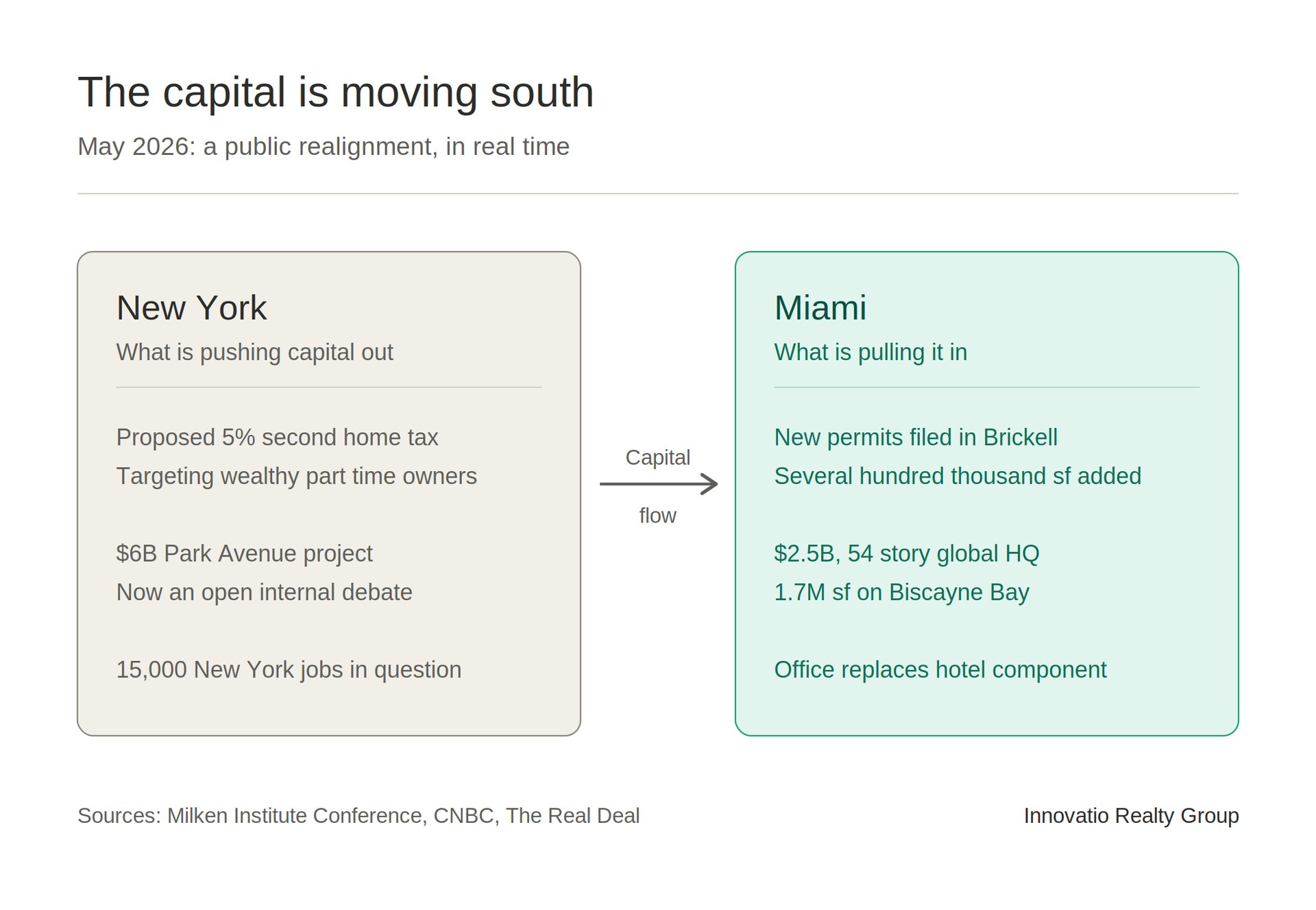
Ken Griffin, founder of Citadel and one of the most influential allocators of capital on the planet, told the world that his firm will "double down" on Miami. The catalyst? A viral Tax Day video posted on April 15 by New York City Mayor Zohran Mamdani, filmed outside Griffin's $238 million penthouse at 220 Central Park South, promoting a proposed 5 percent pied-à-terre tax aimed at the wealthiest part-time residents of the city.
Griffin's response was clear, measured, and consequential. "In reaction to New York, we filed a permit with the city of Miami. We've added several hundred thousand square feet of new space in our new building," he told CNBC. He also revealed that the $6 billion Park Avenue redevelopment in Midtown, originally projected to create roughly 15,000 jobs, has become "a real topic of debate" internally at Citadel.
Read between the lines, and you understand what is actually happening: capital, talent, and influence are recalibrating again. And Miami sits at the center of that recalibration.
Why this is more than a headline
I have watched this pattern before. Griffin moved Citadel's global headquarters from Chicago to Miami in 2022, citing taxes and crime. The result for Chicago was sobering: shrinking office footprints, departing executives, and the quiet erosion of one of the city's most generous civic benefactors. Forbes currently estimates Griffin's net worth at approximately $50 billion. When a force of that magnitude shifts direction, the gravitational pull on adjacent capital is extraordinary.
The Miami story is no longer about relocation. It is about expansion.
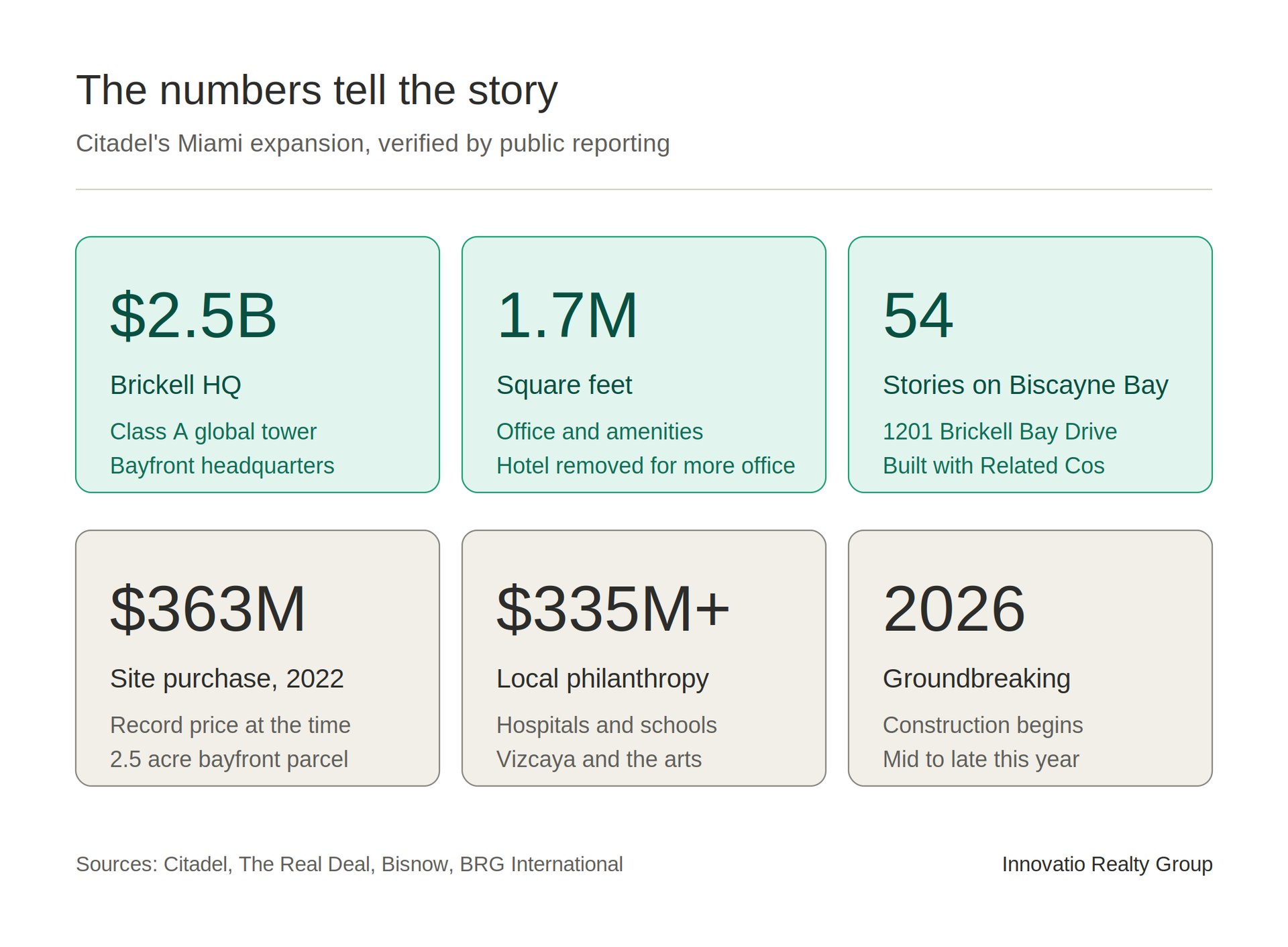
Citadel's planned Brickell global headquarters at 1201 Brickell Bay Drive is now projected as a $2.5 billion, 54-story, 1.7 million square foot tower. Griffin paid $363 million for the 2.5 acre bayfront site in 2022, a record at the time, and is partnering with Related Companies on the development. Just days before the Milken stage moment, The Real Deal confirmed that the original hotel component has been removed in favor of additional office space. That decision, alone, tells you everything about where this market is heading.
And it does not stop with Citadel. Since the original move, a wave of hedge funds, private equity firms, and tech investors has followed, reshaping Brickell's skyline and economy. Griffin himself has personally directed more than $335 million toward South Florida causes, including hospitals, education initiatives, and the Vizcaya Museum. That is the difference between someone passing through and someone building a legacy.
What this means for the people I serve
When the principal of a firm of this caliber publicly states that the New York climate has, in his words, made it clear his partners "need to double down on our bet in Miami because we want to be in a state that embraces business, embraces education, embraces personal freedom", the downstream effect on residential real estate is not theoretical. It is mathematical.
Here is what I am watching in real time, and what my office is preparing for:
want to be careful here, because it is easy to turn a story like this into a real estate pitch. I would rather just tell you what I am noticing.
The first thing is that the office announcement is not really an office story. It is a residential story in disguise. When you add several hundred thousand square feet of new headquarters space in Brickell, you are also signaling future demand for hundreds of executive families who need to live within a reasonable commute of that tower. That demand does not show up in the MLS the week after the announcement. It shows up six, twelve, eighteen months later. The buyers who position ahead of that wave are the ones who win the basis.
The second thing is the herd. Griffin's 2022 move pulled a long wave of hedge funds, private equity firms, and tech investors with him into Miami. The expansion he just announced is going to do the same thing again, in miniature. Some of that movement is already visible in new permit filings. Most of it is still in conversations behind closed doors. I am in some of those conversations. They are real.
The third thing is harder to articulate, but it matters most. When the most public capital allocator in the country goes on a major stage and says, in effect, that he is responding to political pressure in New York by adding capacity in Miami, every other principal at every other firm hears it. They do not have to agree with him. They just have to make a decision. And quietly, many of them are.
A final, honest thought
Click Here To Get Your Brickell Pipeline Report
Every property is an investment. That is true whether you are buying a primary residence, a pied-a-terre, a private office floor, or a pre-construction unit at a development like Nobu Residences by Foster + Partners or Mandarin Oriental Residences Miami, both of which I represent with privileged pricing access for my clients ahead of broader public release. The question that matters is not "do I love this place." The question is "what does this asset do for me, my family, and my position over the next ten or twenty years."
If you are evaluating Miami right now, whether you are relocating, repositioning, or investing for the next cycle, the worst thing you can do is move without a strategist. The second worst thing you can do is wait.
I would be honored to be a resource.
Strategy session with me directly: Book Your Strategy Session
Private Nobu Residences by Foster + Partners briefing: Book a Private Tour NOBU Residences Miami
Private Mandarin Oriental Residences briefing: Mandarin Oriental Residences - Brickell Key