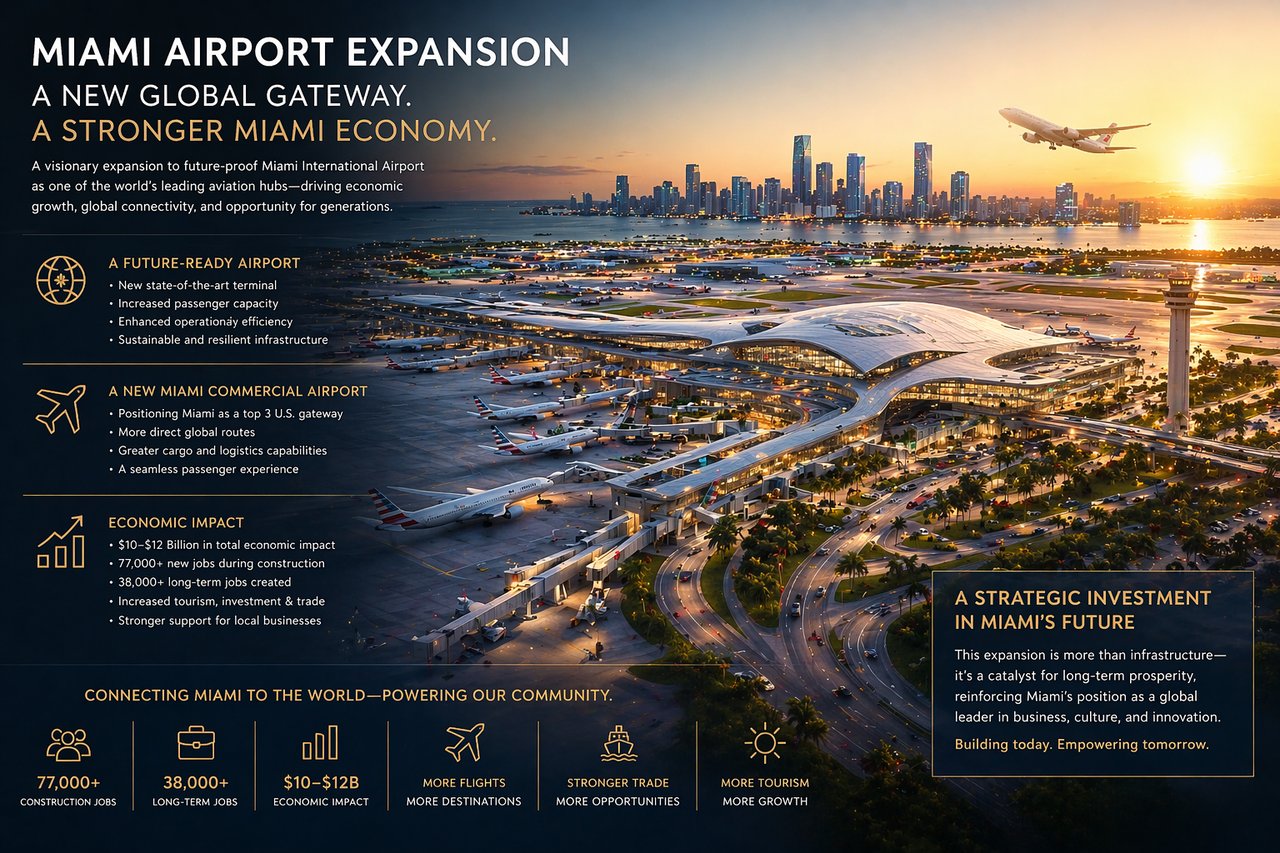
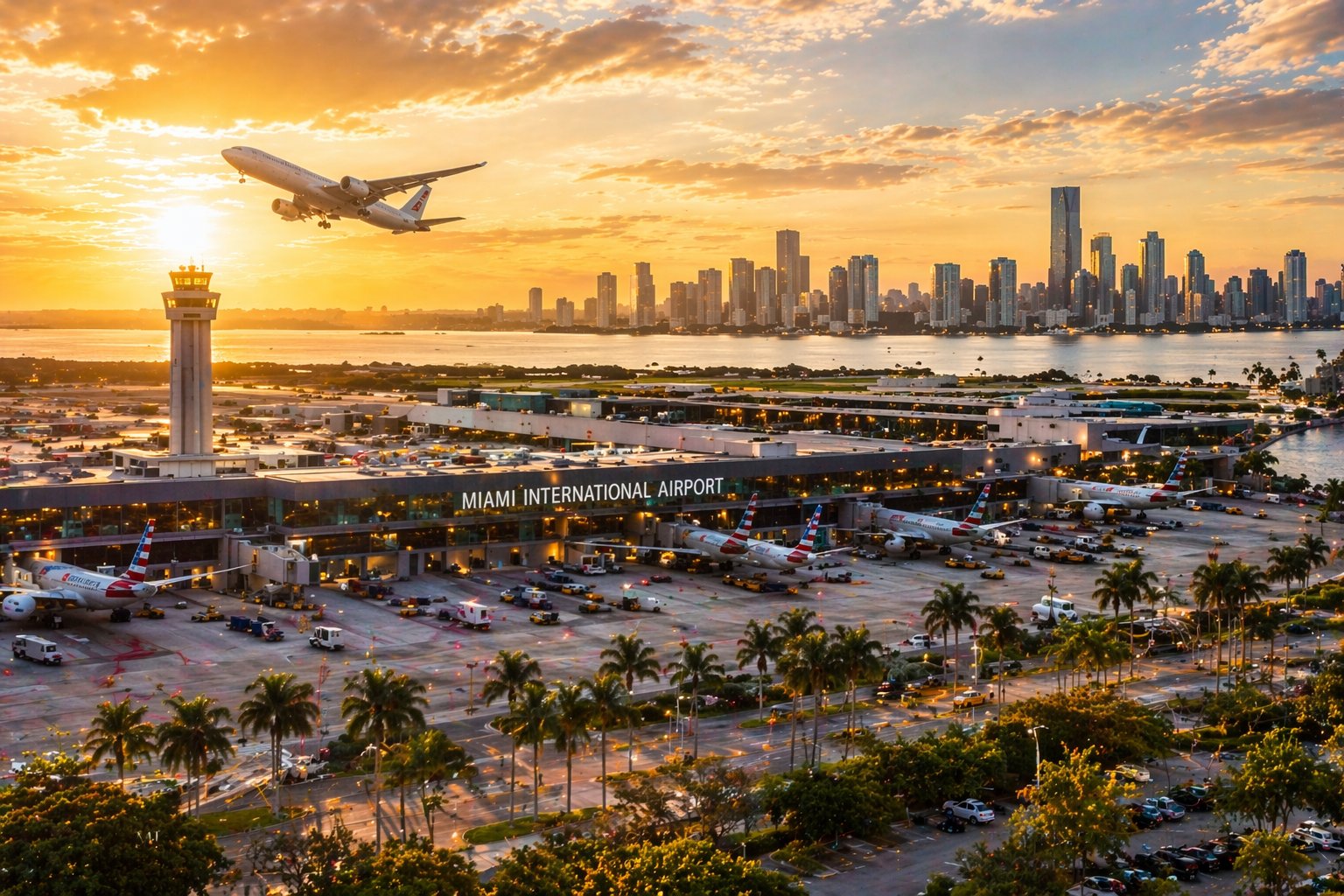
Something historic is taking shape in Miami, and the numbers behind it should reframe how every investor, executive, and family looking at this city is thinking about the next decade.
Let me walk you through what I am watching, the way I walk my own clients through it.
The scale of what Miami International Airport already is
Before we even talk about expansion, it is worth understanding the base we are building on.
In 2024, MIA set a record of 55.93 million passengers, a 7 percent increase year over year. In 2025, it held that position with 55.3 million travelers, making it the second consecutive year above the 55 million mark, even as domestic air travel across North America declined by 2 percent. That outperformance alone tells you what kind of gravity Miami is now exerting.
Cargo tells an even more powerful story. MIA closed 2025 with 3.5 million tons of freight, a 13.6 percent jump and the sixth consecutive record-breaking year. MIA is the number one airport in the United States for international freight and ranks number five globally. It handled 90 percent of Florida's total air trade value in 2023 and approximately 40 percent of the state's combined air and sea trade.
On the passenger side, MIA is the second busiest US airport for international travelers, served by over 80 airlines and 57 passenger carriers reaching 190 destinations worldwide, including new 2026 service to Milan and Caracas.
And in 2025, MIA was named North America's most-improved mega airport by J.D. Power, the Best Airport for Layovers by Global Traveler, one of the Top 10 US airports for food and drink by Food and Wine, and the third best US airport for business travelers by Booking.com for Business.
This is the starting line, not the finish line.
The $9 billion Modernization in Action Plan is already underway
MIA is in full execution of a 10-year, $9 billion capital improvement plan that is reshaping every terminal, concourse, and passenger touchpoint:
- Concourse K broke ground in June 2025. A $600.6 million, 300,000 square foot, three-level expansion adding 6 new gates. MIA's first major terminal expansion in nearly two decades. Scheduled to open Spring 2029.
- Concourse D (Gate D60). A $1 billion reimagining was announced in February 2026. Will convert the current shared boarding area into 17 traditional contact gates with third-level connections to US Customs. Backed by American Airlines as its Latin America gateway. Groundbreaking 2027, delivery 2030.
- Central Terminal redevelopment. A $745 million rebuild is continuing in parallel.
- Ibis Garage. A 2,240-space garage opened in December 2025, expanding parking capacity by 30 percent.
- Over 200 elevators, escalators, and moving walkways are being modernized across the airport, with more than 95 percent of conveyance units now operational.
In 2024 alone, the M.I.A. Plan generated $252 million in business revenue and 2,865 jobs for Miami's construction industry, and we are only at the beginning of the curve.
The second airport, Miami, is preparing for 2040 and beyond
Here is where most of the market is not paying attention yet.
MIA is already operating at nearly 80 percent capacity and is projected to reach 77 million passengers and 4+ million tons of cargo by 2040. That math does not work without a second facility.
On April 17, 2026, the Miami-Dade County Commission voted to fast-track plans for a second major commercial airport. Mayor Daniella Levine Cava's 63-page feasibility assessment narrowed an initial list of eight sites down to three finalists:
- Expanding Miami Executive Airport (Tamiami) into a full commercial facility.
- Upgrading Miami Homestead General Aviation Airport to commercial service.
- Building an entirely new airport on undeveloped land between the two.
The mayor's refined report, including a detailed funding framework, is due June 3, 2026. Commissioner Oliver Gilbert III has signaled that funding will likely come through the Miami-Dade Aviation Department as a proprietary system, via user fees, passenger facility charges, and debt financing, rather than general county revenues.
The second airport would be larger in area than MIA itself, designed to supplement the primary hub, with an earliest operational target of 2038. Without it, officials warn MIA could become as capacity-constrained as JFK or LaGuardia, costing the region billions in lost economic activity.
This is a city planning on two fronts simultaneously. That is not a reaction to demand. That is a declaration of where Miami is going.
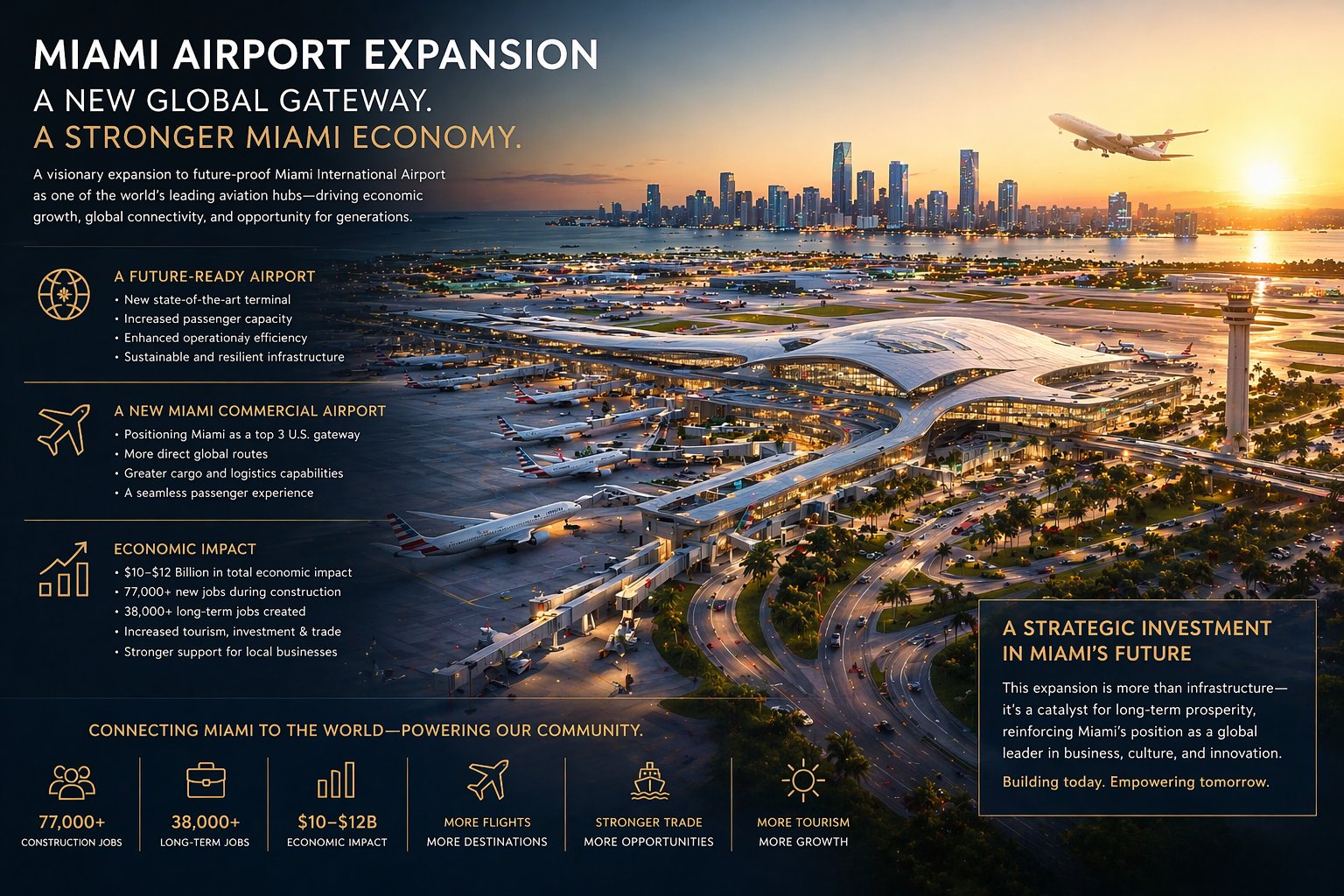
What does this mean for the economy of this city?
The numbers here are extraordinary, and they are why I spend so much of my time making sure my clients see the full picture.
MIA alone generates $181.4 billion in statewide business revenue annually and supports 842,703 jobs across Florida (direct, indirect, induced, and related), according to the 2024 economic impact study by Martin Associates.
In Miami-Dade County alone:
- $41.2 billion in business revenue
- 311,291 jobs, equivalent to one out of every four local jobs
- 60 percent of all international visitors to Florida arrive through MIA
- International visitors spent over $22 billion in 2024
Combined with PortMiami, Miami-Dade's two economic engines produce $242.8 billion in economic impact and nearly 1.2 million jobs across Florida.
When a region of this scale commits to expanding its primary gateway AND planning a second major airport in parallel, four things predictably follow, and I have watched them play out in every global city that has made this commitment before, from London to Singapore to Dubai:
- Capital migration accelerates. More direct international connectivity brings more corporate headquarters, family offices, and institutional capital that choose Miami as a base rather than a stopover.
- Real estate values compound on the long curve. Florida has already been ranked the number one state for global real estate investors for 16 consecutive years. Airport infrastructure investment is one of the strongest leading indicators of multi-decade appreciation.
- Industry diversification deepens. Construction, logistics, hospitality, technology, finance, professional services, and trade all grow around aviation capacity, which is exactly how Miami has shifted from a tourism economy to a full-spectrum global capital.
- Regional value maps get redrawn. The June 3 site decision will reshape corridors in South Dade, around Tamiami, and potentially in entirely new zones. Land, infrastructure, and commercial positioning around the chosen site will look very different in 24 months than they do today.
What I want you to take from this
Miami is no longer a city betting on growth. It is a city building the infrastructure to receive growth that has already decided to come here.
The question is not whether Miami will continue to appreciate as a global capital. The question is whether you are positioning in front of these shifts or chasing them after the fact.
That is the conversation I live in every day with my clients, whether they are relocating a family, deploying institutional capital, acquiring a primary residence, or building a long-term real estate portfolio in this city.
If you would like a private read on how these macro shifts translate into specific opportunities in today's market, I would love to open that conversation.
CLICK HERE To Schedule your Private Strategy Session
Warmly, Katerina Bucciarelli Broker-Owner, Innovatio Realty Group Licensed in Florida, New York, and New Jersey Realm Global Collective | NAR Global | ICREA | CRS | SRS | RENE | Luxury Marketing Specialist