The Service in One Paragraph
From Vision to Address is a private development advisory practice for family offices, ultra-high-net-worth principals, relocating executives, and international buyers who want to source, design, build, and exit Miami luxury real estate as developers, not as retail buyers. Led by Katerina Bucciarelli, licensed broker in Florida, New York, and New Jersey, civil engineer (UNIMET, Magna Cum Laude), and NYU-trained in real estate development process and finance, every project moves through eleven integrated stages under a single point of accountability. From the first vision to the final address.
I am Katerina Bucciarelli, Lic. Real Estate Broker and Founder of Innovatio Realty Group. I am a civil engineer by training (UNIMET, Magna Cum Laude) and NYU-trained in the real estate development process and finance. I run a development advisory practice for the family offices, ultra-high-net-worth principals, executives, and international buyers who want to think bigger than the MLS. Every project moves under one roof. From the first vision to the final address.
This guide is built to bring you value before you ever pick up the phone. The numbers are verified. The framework is real. Read it once, and you will understand Miami development at a depth most brokers cannot teach.
Miami Market Context: The Numbers That Matter in 2026
Before we talk about how to develop in Miami, you need to understand the market you are developing in. The data below is sourced from the 2025 MIAMI Association of Realtors Profile of International Home Buyers, the 2025 NAR International Transactions Report, Knight Frank, CondoBlackBook, David Siddons Group, and Henley & Partners. Verified as of May 2026.
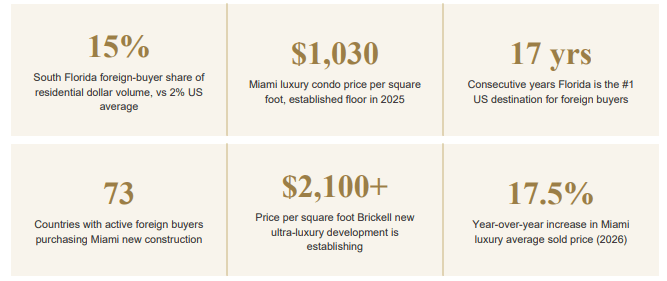
Source: 2025 MIAMI Association of Realtors Profile of International Home Buyers, 2025 NAR International Transactions Report, Knight Frank, CondoBlackBook, David Siddons Group, and Henley & Partners. Verified as of May 2026.
What these numbers mean for development capital. Miami in 2026 is not a speculative market. It is a maturing global city with structural demand that has held its price floor through one of the sharpest interest-rate-tightening cycles in modern history. According to Gay Cororaton, chief economist for the Miami Realtors, wealth migration has been the primary factor sustaining values even when mortgage rates exceeded 6.5%. That is the signature of a deep market, not a fragile one.
Miami-Dade ranks #1 in the United States for international migration. The NYC-to-Miami inter-city wealth transfer is the largest in recent US history, with the IRS Statistics of Income data showing Florida receiving tens of billions in adjusted gross income from New York, New Jersey, and California since 2020. According to Henley and Partners, Florida ranks among the states with the highest growth in ultra-high-net-worth residents in the United States. For Latin American principals, Miami functions as the de facto financial capital of the region, with established capital pathways from Brazil, Mexico, Colombia, Argentina, and Venezuela. For Italian and European principals, Miami sits in a different category than Manhattan or Los Angeles: lower cost of entry per square foot for prime property (per the 2025 Knight Frank Wealth Report, no state income tax, and geographic proximity that makes the move strategically defensible.
Where Capital Is Going: Miami Luxury by Neighborhood
Average sold prices by neighborhood across the last 30 days of 2026 data. This is the map sophisticated capital is using to deploy. Sourced from Brickell Sold and Miami Realtors.
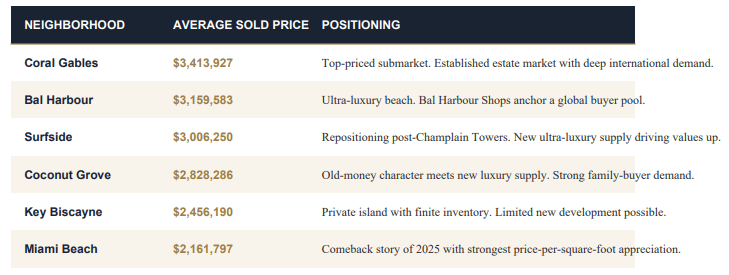
Source: Brickell Sold and Miami Realtors.
In Brickell specifically, the gap between resale buildings (averaging $1,100/SF for best-performing existing inventory) and new ultra-luxury development (establishing benchmarks above $2,100/SF) is widening. That gap is where developer margin lives. Capital that develops in this window captures it. Capital that buys finished retail pays it.
Why Sophisticated Capital Stops Buying and Starts Developing
The wealthy buyer who walks through a beautifully renovated estate in Coral Gables and writes a check for $12 million is buying somebody else's vision at retail price. The wealthy buyer who acquires the tired 1970s estate on the same block for $5 million, demolishes it, builds a new one for $4 million, and lists the finished product at $18 million is operating on a fundamentally different value curve. Same neighborhood. Same lot. Roughly the same end-state product. A $9 million spread captured by the buyer who thought like a developer instead of a consumer.
This is not a theory. This is how generational wealth has been built in Miami real estate for fifty years. Sophisticated Capital makes the shift for four structural reasons.
Compressed retail margin. When finished, Coral Gables estates sell at $1,500 per square foot, and the land plus build costs $900 per square foot; the value created by the developer is the gap. Capital that can access that gap directly captures it. With Brickell's new development establishing $2,100+/SF benchmarks vs $1,100/SF resale, the gap is now wider than at any point in the post-pandemic cycle.
Customization. No finished home, however beautiful, is exactly what a specific principal would have built. Developing means designing the wine cellar, the gym, the home office, the staff quarters, the security infrastructure, and the architectural language exactly to specification.
Privacy. Developing an off-market estate land parcel means the asset never appears in MLS, Realtor.com, or Zillow. Acquisition, build, and ownership all happen under the public radar in a way that buying a marketed property cannot.
Exit timing. A developed asset can be held, occupied, and sold on the principal's timeline, not in response to a builder's marketing calendar.
The Development Math: Real Numbers for a Real Project
Numbers, not adjectives. Here is what a Miami custom build actually costs in 2026, verified from construction cost data published by EZ BH Projects, HCD Group, Blanco Design Build, Seacoast Construction, and Block Renovation.
CUSTOM BUILD COST PER SQUARE FOOT BY TIER (MIAMI-DADE, 2026)
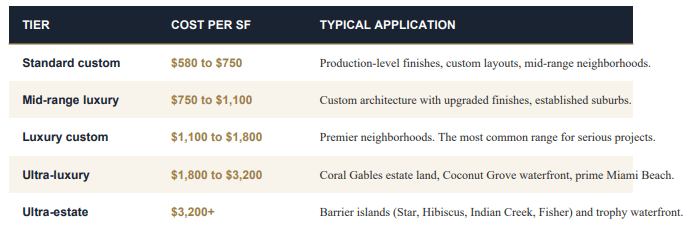
Source: EZ BH Projects, HCD Group, Blanco Design Build, Seacoast Construction, and Block Renovation.
These figures cover hard construction plus soft costs (architecture, engineering, permits, threshold inspection, owner's representation) but exclude land, furnishings, art, decor beyond built-ins, and carry costs. Add 15 to 20% owner contingency on top of any general contractor allowance.
A WORKED EXAMPLE: 8,000 SF CUSTOM HOME IN CORAL GABLES
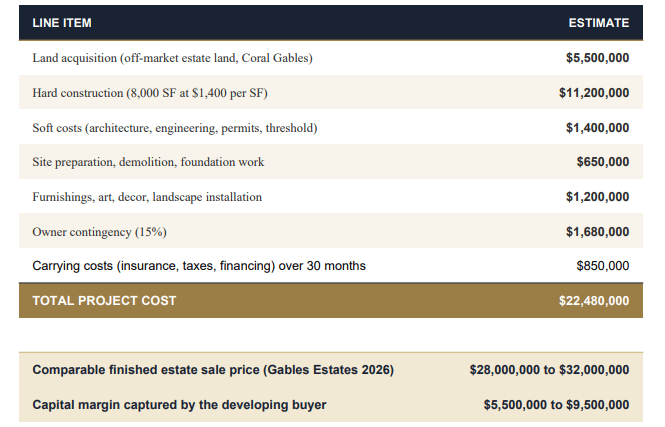
Source: EZ BH Projects, HCD Group, Blanco Design Build, Seacoast Construction, and Block Renovation. (Same construction cost data section)
This is the math. Whether the principal occupies the home for 20 years or sells at delivery, the capital margin between development cost and finished comparable is real, repeatable, and the structural reason sophisticated capital develops. The numbers will vary by neighborhood, lot, design complexity, and timing, but the framework is consistent.
The Path of Development
Eleven stages. Every project I run moves through all of them. I am the single point of accountability across every stage. This is the path.
- VISION AND STRATEGY:
Define the end-state asset, budget envelope, timeline, and lifestyle fit before any opportunity is sourced. - OPPORTUNITY SOURCING:
Off-market estate land, fixer-uppers, distressed acquisitions, subdivisions, and co-development plays through the global network. - DUE DILIGENCE AND FEASIBILITY:
Zoning, comparables, construction feasibility, full financial model with sensitivity analysis. - ACQUISITION AND NEGOTIATION:
Off-market, discreet, structured. Most savings happen here, before a single shovel hits the ground. - VISION TRANSLATION:
Architect selection, strategic space planning, design refinement. The principal sees options, not decisions. - PERMITTING AND ENTITLEMENT:
Municipal, HOA, and historic-preservation submissions structured for first-pass approval. - CAPITAL STACK AND FINANCING:
Construction financing, structured capital, international tax structuring, family office coordination. - CONSTRUCTION AND PROJECT MANAGEMENT:
In-house licensed and bonded contractor. Single schedule. Single budget. Single quality standard. - MARKETING AND PRE-SALES:
Staging coordinated during build. Story, photography, and global broker outreach are ready for delivery. - DELIVERY AND STABILIZATION:
Move-in, lease-up, or listing launch. Each path has its own playbook. - EXIT OR HOLD:
Final close, long-term asset management, generational transfer, or the next first stage.
What Most Buyers Miss: The Hidden Costs of Miami Development
These are the costs that catch unsophisticated buyers off guard, blow project budgets, and turn good investments into mediocre ones. Knowing them in advance is the difference between a developer who runs a clean project and a buyer who learns the hard way.
Hurricane and HVHZ compliance. All glazed openings in Miami-Dade County must meet Miami-Dade Product Approval (NOA) standards for the High Velocity Hurricane Zone. Premium hurricane-impact window systems run $80 to $250 per square foot of glass area installed, versus $30 to $80 for standard insulated glass. On a home with 2,000 square feet of glazing, the HVHZ premium alone adds $100,000 to $340,000 above a non-hurricane zone equivalent. Hurricane-resistant features total 22 to 30% of the overall construction cost in Miami-Dade.
Flood zone elevation requirements. Most Miami luxury parcels sit in FEMA AE or VE flood zones. The National Flood Insurance Program requires the lowest finished floor to be constructed at or above Base Flood Elevation, often with a 1-to-2-foot freeboard added by local ordinance. This drives foundation costs, stair design, accessibility planning, and the entire architectural massing. Plan for elevated slabs and the structural engineering they require.
Builder's risk and windstorm insurance during construction. Builder's risk and windstorm insurance premiums in South Florida have risen 30 to 60% since 2022. Budget $15,000 to $50,000 per year during construction on a luxury project. A 30-month build at the high end is $125,000 in insurance carry alone. Imported finishes, tariff exposure, and supply chain. Luxury Miami buyers expect imported stone, European glazing systems, Italian millwork, and Latin American hardwoods. These materials are subject to tariff shifts and supply chain volatility. Lock material pricing early in the design phase, or be ready to absorb 10 to 25% upward pricing pressure on key categories between contract and delivery.
Permit fees, impact fees, and inspection costs. Local permit and impact fees in Miami-Dade can add $10,000 to $24,000, depending on the county, building type, and project scope. Permits alone for a major custom build can take 6 to 12 months in Coral Gables historic districts and Miami Beach Architectural Review Board areas. Plan timeline accordingly.
Owner contingency (the line most buyers underbudget). Hold 15 to 20% owner contingency on top of any general contractor allowance. The cost of being underfunded on a Miami luxury project (missed milestones, subcontractor demobilization, carrying cost overruns) far exceeds the cost of holding excess contingency that ultimately reverts to the owner.
Custom millwork (the line most contractors lowball). A low bid may allocate $30,000 to $40,000 for cabinetry and built-ins across an entire home. A fully realized luxury residence (custom kitchen, closets, wall cladding, integrated storage, library, wine cellar, millwork) can easily require $300,000 or more in bespoke millwork alone. This is the most common source of change-order pain.
The Five Opportunity Types I Source
Not every opportunity is a project. Here is what I actively source, and the buyer profile each fits.
1. Off-Market Estate Land
Available primarily through relationships in Coral Gables (Gables Estates, Old Cutler Bay, Cocoplum), Pinecrest, Coconut Grove, Bay Harbour, Key Biscayne, and the Miami Beach private islands (Star, Hibiscus, Palm, Indian Creek). These are land or teardown opportunities that never reach MLS. Fits principals who want a fully custom built in an established luxury enclave.
2. Fixer-Upper Waterfront and Estate Homes
Distressed or motivated-seller homes on premium lots where the structure has outlived its value, but the location justifies a teardown and rebuild. The most common development thesis in Miami right now is that the waterfront and estate inventory is finite.
3. Renovation-to-Sale Opportunities
Estate homes that do not need a full teardown but need a comprehensive renovation to compete at the top of their submarket. 12-to-18-month cycle, lower capital deployment, and real margin when executed properly.
4. Small-Lot Subdivision Plays
Single parcels with zoning potential to be subdivided into two or three buildable lots. Less common, more complex, and requires deep local knowledge. Fits sophisticated investors and family offices.
5. Co-Development with Institutional Sponsors
For principals deploying capital alongside an established Miami developer on a larger project. I broker the introduction, the diligence, and the structure.
When the Right Path Is Branded, Not Built
Not every principal wants a 30-month build. For some, the smarter move is acquiring into a fully serviced branded residence where the vision is already realized at the highest standard. Miami’s branded residence market is where some of the most disciplined capital is deploying right now, and three projects define the conversation. Nobu Residences brings the Nobu hospitality standard to a tightly held tower, and I advise principals on it directly as a Nobu Residences advisor. Delano Residences marks the return of one of Miami Beach’s most iconic names as a ground-up branded tower, and I guide buyers through that opportunity as a Delano Residences advisor. And for principals weighing the two leading branded options on the water, I have published a direct, side-by-side analysis comparing Nobu Residences versus Mandarin Oriental Residences so the decision is made on facts, not marketing. Whether you build from vision or acquire a finished branded asset, the lens is the same: long-term value, equity, and return.
For International Principals: The Tax and Structuring Layer
If you are buying in Miami as a non-US person, the tax and structuring layer is where 90% of expensive mistakes happen. Sourced from the 2026 Miami, Florida Tax Guide, FIRPTA documentation, and the 2025 NAR International Transactions Report.
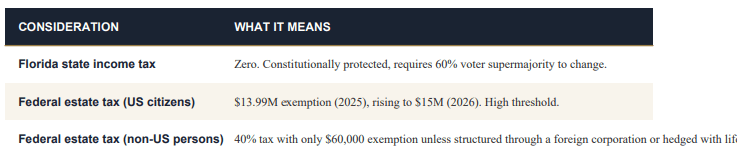
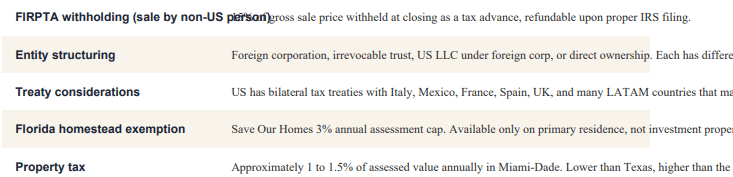
Source: 2026 Miami, Florida Tax Guide, FIRPTA documentation, and 2025 NAR International Transactions Report.
I am trilingual in English, Spanish, and Italian, and I coordinate directly with international tax counsel, US estate planning attorneys, and family office advisors to ensure the ownership structure protects the asset, the income stream, the eventual exit, and the generational transfer. None of this should be improvised at the closing table. It should be modeled before the offer is written.
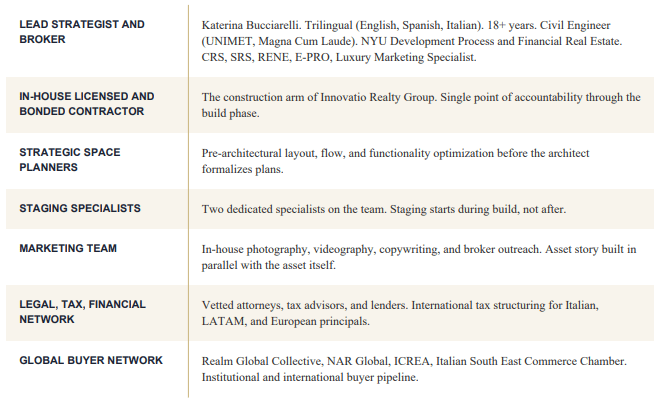
The One-Stop Team You Get Under One Roof
This is what separates Innovatio Realty Group from every other brokerage in Miami. When you engage me, the team is integrated, not subcontracted.
What This Looks Like in Practice
Without naming a specific client, here is the shape of a typical project. Numbers are illustrative but reflect real Miami market conditions in 2026.
A principal relocating from a major financial center wants a 12,000-square-foot custom estate in Coral Gables with a wine cellar, staff quarters, home gym, guest house, and resort-style outdoor living. Budget envelope: $18 to $24 million all-in. Timeline tolerance: 30 to 36 months.
Stage 1, vision session. 90 minutes with the principal and family. Asset, use, long-term plan, and financial envelope are defined.
Stage 2, sourcing. Three to six months working on the network. Three off-market opportunities were brought to the table:
Gables Estates (waterfront, teardown, $7.5M asking), Cocoplum (estate land, $6.2M asking), Old Cutler Bay (partial renovation, $5.5M asking).
Stages 3 to 4: due diligence and acquisition. All three diligenced in parallel. Gables Estates becomes the clear winner on structural feasibility and resale comparables. Off-market acquisition negotiated at $6.4M, saving the principal $1.1M against the initial ask before any other work begins.
Stages 5 to 6, design and permitting. Architect matched to vision. Strategic space planning runs six months. Permitting in parallel for another six to nine months given Coral Gables historic and architectural review.
Stages 7 to 8, capital and construction. Capital stack structured with the family office. Construction begins with the in-house contractor. Build runs 22 to 26 months. 12,000 SF at $1,500 per square foot hard plus soft costs lands at approximately $19 million in construction.
Stages 9 to 11, delivery and beyond. Move-in coordinated. Final styling closes the project. Total project investment is approximately $26 to $28 million all-in. Comparable finished Gables Estates trades currently at $35 to $42 million, with the resale upside reserved for the principal's timeline.
Total elapsed time from first conversation to keys in hand: 32 to 38 months. Total integrated team coordination: under one roof. Total points of contact for the principal: one. This is what development advisory looks like when it is done correctly.
Who This Service Is For
I do not take every project. Development advisory is the most resource-intensive engagement I run, and the right principal makes the difference.
THIS SERVICE IS FOR YOU IF YOU ARE:
• A family office or principal deploying $5 million or more into a single project, and you want a strategist rather than
a transaction broker
• A relocating executive, founder, or finance professional who wants a custom home in Miami's premium submarkets
and is comfortable with a 30-month build horizon
• An international buyer from Italy, LATAM, the Middle East, or Europe who wants a discreet, structured acquisition
and a Miami advisor who speaks your language
• An investor who has decided that retail-priced luxury inventory does not justify the capital deployment, and you
want exposure to the developer's margin
• A multi-generational family that wants to build the asset that will pass to the next generation, not buy somebody
else's compromise
• A founder or operator who has built businesses and wants to apply the same operating discipline to a real estate
development
This service is not the right fit if you are looking for a fast purchase, a turnkey home you can move into in 60 days, or
a transaction-only relationship.
Frequently Asked Questions
Q. How is this different from hiring a developer directly?
A. A developer represents the developer's interests, deploys the developer's capital, and runs projects the developer wants to run. I represent your interests, deploy your capital, and run the project you want to run. The economics, the timeline, the design decisions, the eventual exit, and the upside are all yours.
Q. How are you compensated on a development advisory engagement?
A. The structure depends on the project. For acquisitions, I am paid the standard real estate commission by the seller. For construction phases, the contractor team is paid on a fixed-fee or cost-plus basis, depending on the project structure. For marketing and sales at exit, I am paid the listing commission. The principal sees every cost, every margin, and every line item. There are no hidden fees.
Q. What is the typical capital range for a project you take?
A. I generally engage in single-project deployments of $5 million and above. Below that level, the development advisory model rarely produces enough margin to justify the time commitment over a faster acquisition path. Above that level, the math compounds in the principal's favor.
Q. How long does a typical project take?
A. For a single-family custom build on acquired land, 30 to 36 months from contract through move-in. For a fixer-upper renovation, 12 to 18 months. For a small-lot subdivision, 24 to 36 months, depending on entitlement complexity.
Q. Do you only work in Coral Gables and Miami Beach?
A. I work across Miami-Dade County and the surrounding areas. I am licensed in Florida, New York, and New Jersey. My strongest networks are in Coral Gables, Pinecrest, Coconut Grove, Bay Harbour, Key Biscayne, Sunny Isles, and Miami Beach private islands, and the new Brickell and Downtown supertall corridors.
Q. What is the biggest risk in Miami development right now?
A. The hidden cost layer (HVHZ compliance, flood elevation, insurance premiums, imported material tariffs) catches unsophisticated capital off-guard and erodes margin. The second risk is permitting timeline variability. The third is contractor execution risk. Working with an integrated team mitigates all three.
Q. Can you also represent me on the eventual sale of the developed asset?
A. Yes. In most engagements, the same team that develops the asset also markets and sells it at exit. This is the most efficient and most aligned structure.
Q. What if I do not yet know whether I want to develop or buy?
A. Start with a strategy session. We will walk through what you actually want from the asset, your capital, and timeline, and the right move for your situation. Sometimes the answer is to buy. Sometimes the answer is to develop. Sometimes the answer is to wait. I will tell you what I actually think.
Why Work With Me
I am Katerina Bucciarelli. I am a licensed real estate broker in Florida, New York, and New Jersey. I am a civil engineer by training (UNIMET, Magna Cum Laude) and NYU-trained in the development process and financial real estate. I have 18+ years in this industry, every CRS, SRS, RENE, E-PRO, and Luxury Marketing Specialist designation in my profession, and a network that puts me #intheroom on every meaningful project, opportunity, and transaction in this city.
What that means in practice: I read structural reports as an engineer. I model returns as a developer. I source opportunities as a broker. I negotiate as one of the best in this market. I run construction with an in-house team. I market the finished asset to a global buyer pool. I advise across the entire arc.
Most importantly, I do not chase transactions. I build relationships. Many of the principals I work with on development engagements are second-project clients, third-project clients, family-referral clients, or wealth-advisor clients referrals. The Ninja Selling philosophy I run my practice on is simple: bring value first, be the source of the resource, and let the work speak. This document is part of that philosophy. You have just spent twenty minutes inside my actual thinking on the Miami development market. That alone, whether or not we ever work together, is worth more than most strategy sessions cost.
Schedule Your Private Development Advisory Strategy Session
This is a conversation, not a sales call. Thirty minutes on your situation: what you want to develop, what your capital looks like, what your timeline looks like, and what the right next step is. If developing is not the right move for you, I will tell you. If it is, we will scope it.
BOOK THE DEVELOPMENT ADVISORY STRATEGY SESSION
calendly.com/kate-roundtable/from-vision-to-address
OR BOOK A BROADER MIAMI STRATEGY SESSION
calendly.com/kate-roundtable/strategy-session
FULL NETWORK AND DIRECT ACCESS
liinks.co/katerinab
innovatiore.com